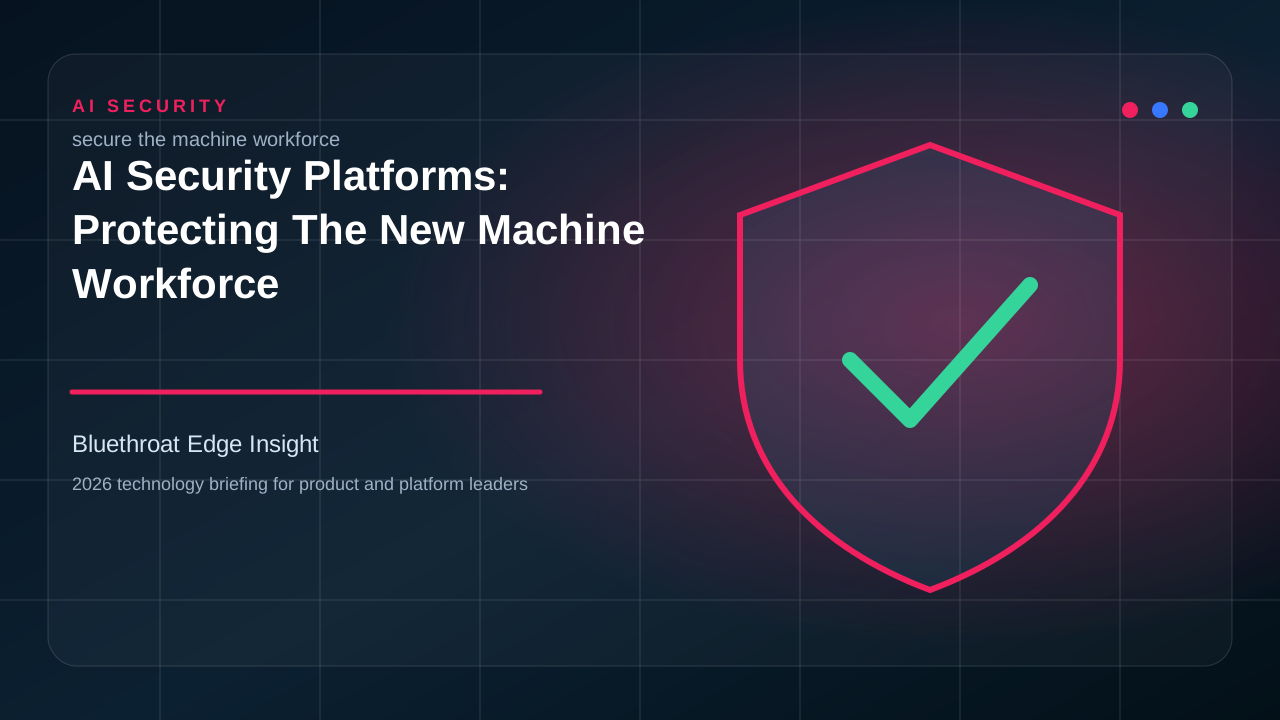
AI Security Platforms: Protecting The New Machine Workforce
 Bluethroat Edge
- September 21, 2026
- 7 min read
AI is becoming both a defender and an attack surface. Security teams now need controls for models, agents, prompts, data flows, plugins, APIs, and non-human identities.
Why this matters now
As AI moves deeper into enterprise workflows, the security perimeter is expanding. It no longer covers only users, devices, applications, and cloud services. It also covers AI agents, model outputs, prompts, datasets, plugins, and automated actions.
World Economic Forum research shows AI is becoming a defining force in cybersecurity. Gartner identifies agentic AI oversight, AI security platforms, and identity for AI agents as major 2026 cybersecurity priorities. The message is clear: AI needs its own security architecture.
The new risks
Common risks include prompt injection, data leakage, rogue agent actions, excessive permissions, model misuse, shadow AI tools, and unclear accountability when an agent acts across multiple systems.
Traditional identity and access management was built around humans. Agentic systems introduce machine actors that can hold credentials, call APIs, and run workflows. That means access policies need to become more granular, more observable, and easier to revoke.
The practical response
Organizations should create an AI asset inventory, classify data exposure, approve sanctioned AI tools, red-team agent workflows, and monitor model inputs and outputs for policy violations.
Security leaders should treat AI as both a risk and a defensive advantage. AI can help with detection and response, but only when the models themselves are governed, logged, tested, and constrained.
The signal for leaders is simple: treat this as an operating-system shift, not a feature trend.
- Bluethroat Edge
Practical Moves For Leadership Teams
- Inventory sanctioned and shadow AI tools
- Treat agents as non-human identities
- Add prompt and output monitoring
- Use AI defensively with governance
Sources And Signals

Planning a product around this shift?
Bluethroat Edge can help shape the roadmap, user journeys, architecture, integrations, automation layer, and launch plan for your next platform.
Start A ConversationAbout Bluethroat Edge
Bluethroat Edge builds websites, CRM, ERP, fintech systems, marketplaces, mobile apps, dashboards, AI workflows, and custom business platforms.
Proof Board
Built by Bluethroat Edge
Recent Posts
Agentic AI Workflows: From Prompts To Delegated Work
Post-Quantum Readiness: Why Crypto Inventory Starts Now
AI Infrastructure At The Edge: The New Cost, Cloud, And Energy Equation
Physical AI And Robotics: When Software Starts Moving The Real World
Contact us
Have a product, platform, or article idea to discuss?
Send